How to make Probiotic Yogurt
More coming soon…
To make yogurt, follow the times and temperatures on the cheat sheet below and follow these steps:
- Sterilize all your containers and utensils, keep everything clean or risk rotten product.
- Assume you are making a quart jar or bowl, put about 2oz of ultra pasteurized half-n-half in the container… if not ultra pasteurized, you will need to bring milk to 180F for 20 minutes to sterilize it. A2 is great for people that struggle with dairy.
- Slowly add 2 tablespoons of prebiotic (usually Inulin) while whisking so that it does not clump, prefer to use my mixer with a single whisk beater, or I upgraded to this handy compact cordless mixer.
- Add the starter powder either by opening the pill or packet and whisk it in
- Add remainder of half-n-half to fill the container leaving some space at the top for expansion
- Leave lid loose to breath and place in your incubator (yogurt maker or instant pot) according to the temperature and time listed in the cheat sheet
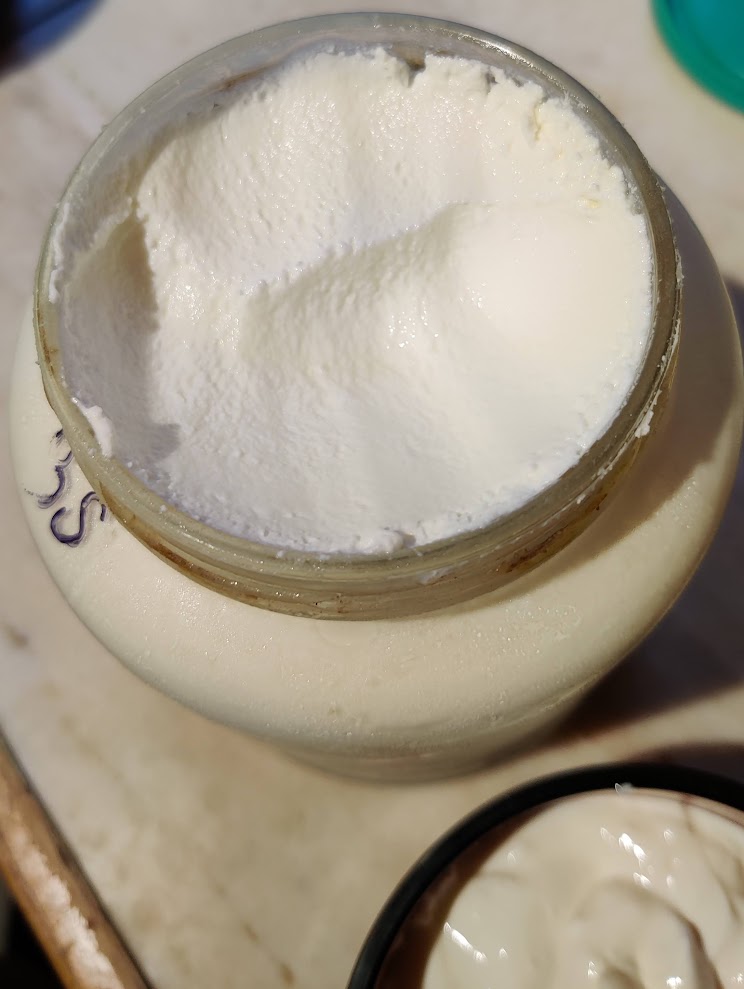
- After time has completed put your yogurt in the fridge for 4-8 hours until it completely cools, it will firm up during this time, then it is ready to eat.
- Save some from this first batch to make starter for next batches, you will want to freeze 2 tablespoon samples for future use
- Smell your yogurt, you might note some liquid separation (whey), this is fine and perfectly healthy, but if it has a nasty smell you probably did not sterilize something.
- As container gets consumed, just leave ~2 table spoons of yogurt in it and start a new batch. (see notes below)
If you need supplies, check out our shop
When you are ready to eat, you can mix with cinnamon and vanilla, or fruits, and some people like a bit of sweetener such as honey, monk fruit or stevia. We typically mix 4-5 strains of yogurt when we are ready to eat it, the suggested dose is about 1/2 cup per day, we do 1-2 tablespoons per strain.
Making consecutive batches:
Use same instructions as above, except you no longer need a pill or bacteria starter powder (prebiotic powder is needed), you will use about 2 table spoons of your first batch as the starter for consecutive batches
Some people find that 5-10 child batches can be made just by saving ~2 table spoons in your container and adding half-n-half and inulin, after a certain point the batch might end up with a lot of liquid separation, this could mean you over cooked it, or bacteria count/quality has dropped off, and you need to use a fresh starter. The best thing to do is to take several samples from your first batch and freeze them, each 2 tables spoon sample you take can make 5-10 child batches, so 5x 2TBS samples can make 50 quarts of yogurt.
Non-dairy option coming soon for our intolerable friends, hint: think coconut.
Using raw milk is ok, but has little benefit other than you know where it came from, you will need to sterilize your raw milk to use it, goat milk can also be used for those that are lactose intolerant, just make sure to pasteurize it, it will not firm up as much as half-n-half. Be sure to give A2 milk a very good look over if you have “dairy issues”, it could solve those.
Many people keep all their bacteria separate, but I ferment my L. Reuteri with my L. Gasseri in the same container, others stay separate. When I eat them, they all get mixed together in the same bowl.
Probiotic Strain Cooking Cheat Sheet
Here is a quick cheat sheet of each products temperature range, compatibility and preferred prebiotics:
Home fermentation · culturing parameters
Temperature, duration & prebiotic feed by strain
Starting points for home-culturing each strain in dairy (or juice, for S. boulardii), based on independently published data. Adjust from here based on your own results — potency, milk fat content, and starter freshness all shift ideal timing.
| Strain | Temp range | Ideal temp | Ferment duration | Preferred prebiotic |
|---|---|---|---|---|
| L. reuteriLRDR | 95–100°F (35–38°C) | 99°F (37°C) | 36 hours | Potato starch or FOS/inulin, 1–2 tbsp per quart |
| L. gasseriBNR17 | 98–100°F (36.7–38°C) | 100°F (37.8°C) | 36 hours | Required — FOS/inulin, 1–2 tbsp per quart |
| B. subtilisHU58 | 85–100°F (29–38°C) | 86°F (30°C) | 24 hours | Not required — spore-former; potato starch or Inulin optional |
| L. paracasei Shirota | 95–100°F (35–38°C) | 99°F (37°C) | 24 hours | FOS/inulin, 1 tbsp per quart |
| S. boulardiiCNCM I-745 | 90–100°F (32–38°C) | 99°F (37°C) | 24–48 hours | Not needed — feeds on juice sugars directly |
- L. reuteri: No LRDR strain-specific fermentation data has been independently published — figures reflect L. reuteri’s general published optimal growth temperature (37°C).
- L. gasseri: Needs steady warmth and a full 36-hour ferment to grow properly — shorter or cooler ferments under-develop it. Can be cultured alongside L. reuteri in the same batch.
- B. subtilis: No HU58-specific home-fermentation data is published; ideal temp reflects general published B. subtilis growth optima. Cannot be cultured in the same batch as L. reuteri/L. gasseri — ferment separately.
- L. paracasei Shirota: Based on Yakult’s own manufacturing spec (37–38°C). Not compatible to culture with other strains — ferment separately (e.g. one bottle of Yakult per quart of half-and-half).
- S. boulardii: A yeast, not a bacterium — ferments in unsweetened juice (cherry, pomegranate) rather than dairy. Optimal growth temperature confirmed at 37°C in peer-reviewed research.
L. Paracasei Shirota (Yakult) - the mind clearer and sleep aide.
This is made by first getting a pack of Yakult from your local store.
- Use 1 bottle of Yakult with 32oz of half-n-half, and 2 table spoons of prebiotic Inulin.
- Follow the rest of the directions for normal yogurt making and the cheat sheet.
- This could be fermented in separate containers, but in the same batch with other products that use the same temperature and duration combos, anything in the 99~100F range running for 24 hours.
- NOTE: Dr. Davis says to run this ferment for 36H @ 109F, which is outside of this bacteria’s optimal range and actually stresses it slowing reproduction, running it at its optimal temp will allow it to produce faster and higher CFU counts.
S. Boulardii (Florastor) Juice
Florastor makes a fantastic sparkling juice, just put the contents of 1 pill in a 32oz juice, leave lid vented 24-36 hours, then seal TIGHT for a few more hours, then refrigerate to drink. Check this short video to see more.
You can refer to Dr. Davis recipes here if you like. Or get his Super Gut book here.